
Modernizing Communication at Industrial Ports with Android-Based Push-to-Talk App Solution
Client: Large-Scale Industrial Port Authority
Solution: StackPTT App (Push-to-Talk over Cellular)
Developer: Stackiot Technologies Pvt. Ltd.
Background
Challenges
The port faced the following key communication obstacles:
- Limited Coverage: Traditional radio networks could not reach all areas of the sprawling port, especially remote corners and indoor facilities.
- Infrastructure Dependency & Cost: Maintaining and expanding radio towers and repeaters was costly.
- Interdepartmental Silos: Security, marine operations, and cargo teams could not easily communicate across different radio channels or systems.costly.
- Interdepartmental Silos: Security, marine operations, and cargo teams could not easily communicate across different radio channels or systems.costly.
- Integration Needs: The port needed to connect mobile users (smartphones), control room operators, and existing radio users on a single platform without disrupting legacy investments.
Solution Deployed
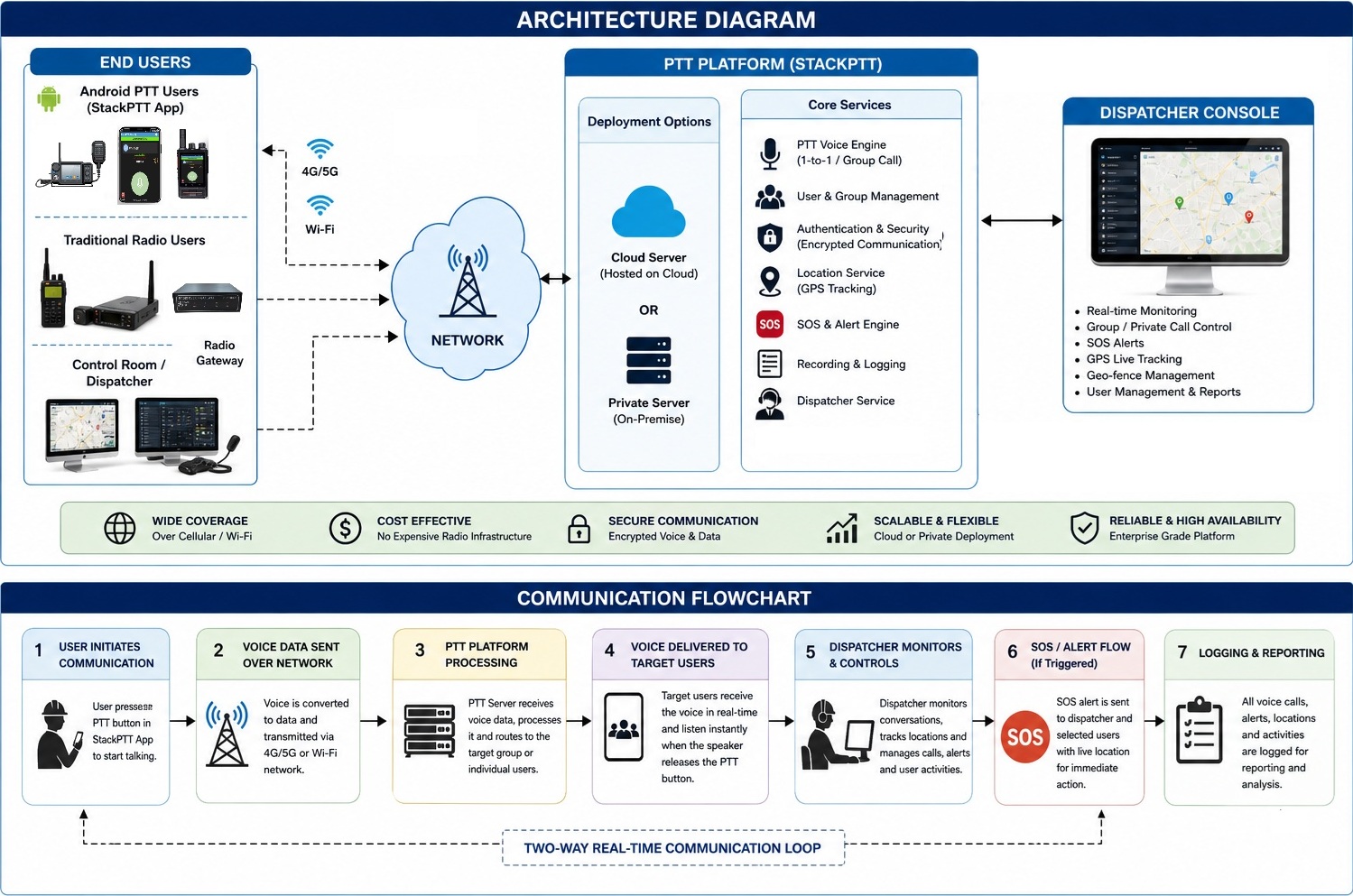
The port implemented StackPTT, an Android-based Push-to-Talk application (PoC) that operates over cellular or Wi-Fi networks. The solution transformed standard Android devices into digital two-way radios.
Key Features Utilized:
• Instant PTT Communication: One-to-one and group calling with a single button press.
• Cloud & Private Server Options: Hybrid deployment for flexibility and security.
• GPS Integration: Real-time location tracking of all field personnel.
• Dispatcher Console: Centralized monitoring, private/group calling, and emergency management.
• SOS Alerts: Instant distress signals with location data.
• Geo-Fencing: Virtual boundaries that trigger automatic alerts
• Legacy Radio Integration: Integrated traditional radio users and Android app users into the same talk groups. Deployment Advantages:
• Easy Installation: No extensive infrastructure modifications were required.
• Wide Coverage: Leveraged existing cellular networks across the entire port.
• Cost-Effective: Reduced need for new radio hardware; used existing smartphones and android radio.
• Gradual Migration: The port could phase out old radios over time without disrupting daily operations.
Deployment Advantages:
• Easy Installation: No extensive infrastructure modifications were required.
• Wide Coverage: Leveraged existing cellular networks across the entire port.
• Cost-Effective: Reduced need for new radio hardware; used existing smartphones and android radio.
• Gradual Migration: The port could phase out old radios over time without disrupting daily operations.
Results & Benefits
| Area | Outcome |
|---|---|
| Communication Efficiency | Real-time cross-departmental communication eliminated silos. |
| Response Time | Faster coordination for cargo handling and emergency incidents. |
| Operational Visibility | Dispatchers gained live GPS tracking and location history. |
| Safety Enhancement | Geo-fencing and SOS alerts improved worker safety, especially in remote areas. |
| Interoperability | Legacy radio users and Android app users communicated seamlessly in mixed talk groups. |
| Cost Savings | Reduced reliance on expensive radio infrastructure and maintenance. |
Conclusion
This case study demonstrates how an Android-based Push to talk app solution like StackPTT can revolutionize industrial port communications. By combining mobility, real-time visibility, and the ability to integrate with legacy systems, the solution provides a future-proof, scalable communication platform that enhances both operational efficiency and worker safety — all with minimal deployment complexity.